Busy Is Not Productive
Modern workplaces often confuse visible activity with meaningful progress. This article examines why busyness, utilization, and completed tasks are poor proxies for productivity, and why better results often come from improving workflows, reducing unnecessary work, and focusing on value rather than activity.

FIG 1.0 - Opening the the same outlet to be as conscious as possible.
Sometimes, a simple observation of what is around us holds more value than trying to be overly connected to systems and having the same information multiple times isn't going to improve it's delivery.
Related Insights
Should we Rethink How to Use AI?
Productivity Is Not What We Think It Is
Using the bad metrics for productivity

MXI.STUDIO EDITORIAL
Productivity | Work | Metrics | Operations
The MXI.Studio Editorial is a collection of articles, ideas, and reflections written by the people behind MXI.Studio. We explore emerging technologies, innovation, industry trends, and the current challenges of an ever-evolving world.
Busyness does not prove productivity
A calendar can be full of task without necessarily showing what was actually accomplished. Messages can be answered, task can be fulfilled, meetings can be done and reports can be delivered while the source of the problem stay still either undiscovered or unresolved.
"Busyness is easy to see. Productivity is harder to comprehend."
The previous article, Productivity Is Not What We Think It Is, treated productivity as a property of a work system rather than a collection of techniques for getting more things done. That distinction raises a second question: why do we so frequently use visible activity as evidence that we are being productive? The short answer is the illusion of progress and the ease of measuring metrics.
The modern visibility problem
Many of today’s processes create an ongoing trail. There is a schedule that has planned activities. There are messaging systems that show responses and status. The to-do list shows completed activities. The document maintains the changes, while the dashboard presents everything in graphs.
Those are indeed useful records. They allow work to be coordinated, responsibilities to be clarified, and problems to be detected. The trouble begins when evidence that something happened is treated as evidence that something important happened.
Think about the following two examples. On the first day, a project team participates in many meetings, creates a new presentation and updates all of the tasks on their board. On the second day, a technical expert realizes that the initial assumption of the project is incorrect and suggests that the project be stopped because of the expense involved. The first day generates more visible cues. The second may prevent months of unnecessary rework. This is an example, but the distinction is practical; the quantity of observable activity does not establish its contribution.
Visibility also changes reasonings. When responsiveness, meeting attendance, and completed tickets become informal signs of commitment, people have reasons to keep producing those signals. Work that requires concentration, uncertainty, or a period without visible output becomes harder to defend. The organization risks rewarding evidence of effort instead of the results that effort was intended to create. This is what we often see and resume as, for example, “he is just sending e-mails all day”.
W. Edwards Deming's broader argument in Out of the Crisis is relevant here; performance must be understood through the system producing it, not merely through isolated figures. A number becomes useful when its relationship to an important result is clear. Without that relationship, measurement can encourage the wrong behavior.
Four different levels of work
A more precise vocabulary helps separate the different signals. Activity, output, outcome, and value describe four related but different levels of work.
Tab 1 — Four different stages in work shown through a customer-onboarding project.
The order is important here because each stage answers a unique question. Just completing the interviews does not provide a helpful guide, and producing the guide will not necessarily make the customers change their behavior either. A measurable gain may not always justify an expensive implementation strategy.
The categories are an analytical framework, not a universal accounting standard. They help identify where a claim about productivity stops being supported by evidence. Formal productivity statistics make a related but narrower distinction. For instance, the U.S. Bureau of Labor Statistics describes labor productivity as output per hour of labor input. This is a ratio between production and resources, not a count of how active a person appeared. Translating that concept to an individual knowledge-work task is difficult because useful output may be collaborative, delayed, qualitative, or impossible to attribute to one employee.
This challenge does not make the use of metrics useless. Handled calls, reviewed documents, and completed tickets may tell about the level of workload or capacity or any operational issues. This becomes misleading when the meaning is subtly changed from work performed to value created.
A responsible evaluation therefore follows the chain. What was produced? What changed because of it? Who benefited? What resources, risks, and unwanted consequences accompanied that change? When the chain cannot yet be completed, the uncertainty should remain visible rather than being replaced by a convenient activity count.
How full utilization became an objective
-
a configuration file for metadata and runtime behavior
-
a CSS file for encapsulated styling
-
an HTML template for structure
-
a JavaScript module for logic and lifecycle handling
The appeal of busyness has a recognizable economic logic. Labor, equipment, and facilities cost money. Therefore, if a resource is available but not operating, unused capacity can appear to be a loss. In repetitive processes with predictable demand, reducing avoidable idle time can indeed improve output.
"The problem is extending that intuition to every kind of work."
Knowledge work is never a uniform flow of work passing through a single and isolated process. The level of difficulty changes; data come in chunks; and the whole process may depend on the outcome of some other process. For example, the engineer may finish the implementation but still wait for the evaluation. The designer may be ready with the choices but needs a strategy decision. A manager could remain busy all day while the critical dependency remains untouched.
Keeping every individual fully occupied does not necessarily increase the speed of the whole operation. It can instead create more unfinished work and more dependencies waiting in line. Drucker's The Effective Executive places emphasis on effectiveness and contribution rather than effort alone. Deming similarly challenges the assumption that optimizing individual parts automatically optimizes a system. Applied to the workplace, the implication is straightforward: a high utilization figure for each person is not proof of a high-performing organization.
The relevant unit of analysis is often the flow of useful work from request to result.

FIG 2 - Setting up the week in advance.
When being productive is a matter of filling calendar apps or writing a lot of tickets, we start feeling pressured to fill it at all cost, even with events that are otherwise obsolete.
The utilization paradox
A system needs some available capacity to respond when work arrives unexpectedly. As utilization approaches its practical limit, even ordinary variation can produce waiting lines. A review team, for example, may be capable of handling its average weekly volume. Yet requests do not arrive at perfectly even intervals, and every review does not take the same amount of time. If all available hours have already been allocated, a difficult request or a sudden burst of arrivals creates a backlog. The next request waits, followed by the next. Everyone can remain busy while completion times become less predictable.
Queueing theory describes why this happens. John D. C. Little established a fundamental steady-state relationship: work in progress = throughput × average time in the system, commonly written as L = λW. At a given throughput, an increase in unfinished work corresponds to a longer average time before completion. Little's Law does not, by itself, state that high utilization causes delay. That additional relationship depends on variability and the assumptions of a particular queueing model. In a simple single-server model with random arrivals and service times, the predicted time spent in the system rises sharply as utilization nears 100%. Figure 1 illustrates that theoretical behavior; it is not a measurement of actual office workers.
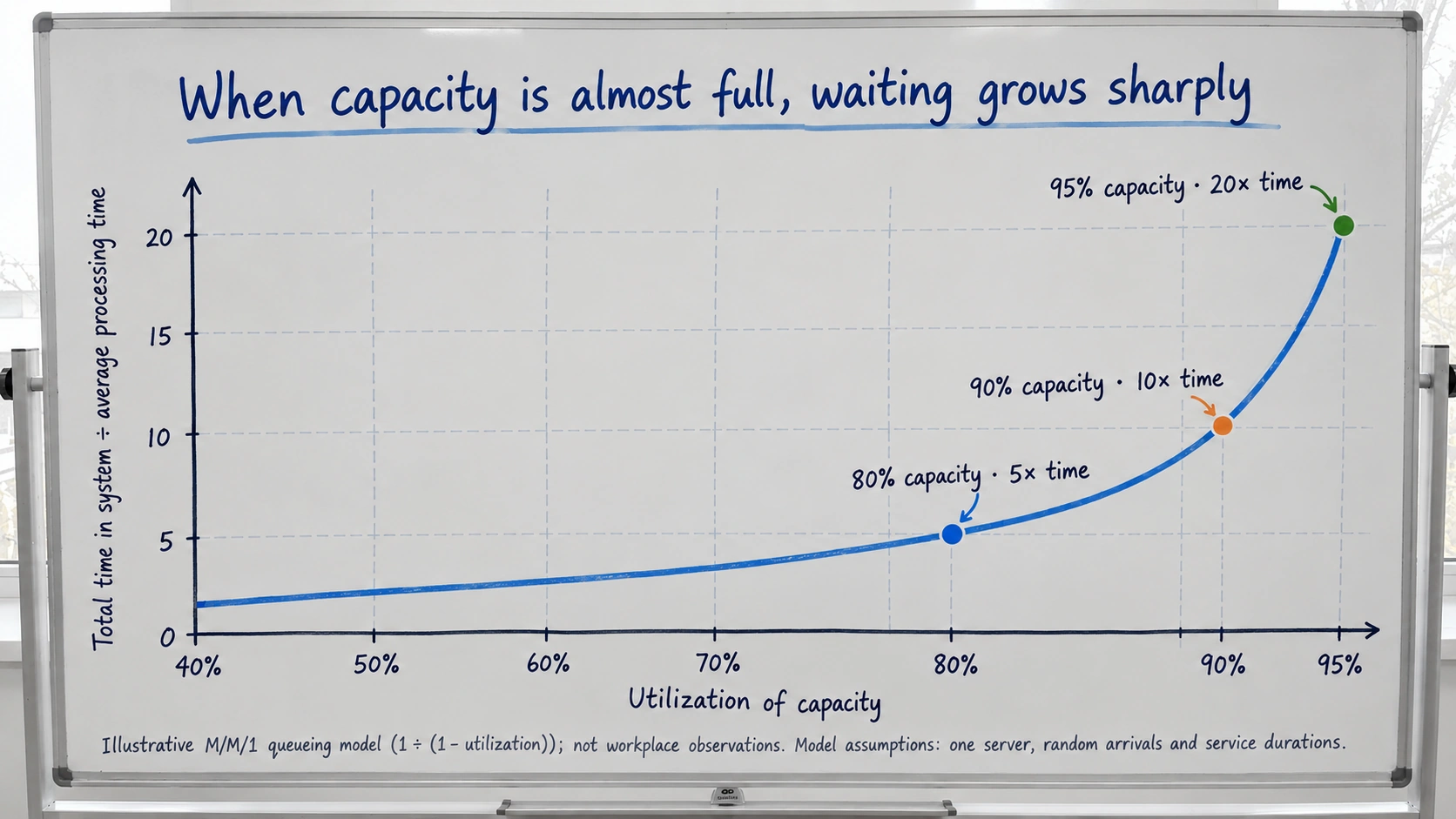
FIG 3 - queueing curve capacity and waiting time relationship illustrated.
Being busy isn't the same as being productive. As workloads approach full capacity, small interruptions can cause disproportionately large delays. True efficiency isn't about filling every available hour, but leaving enough room for flexibility and the unexpected. Sometimes, doing less is what allows us to achieve more.
The practical lesson is not that every team should target the same utilization percentage. Work systems differ in urgency, variability, staffing, and tolerance for delay. Rather, slack should be evaluated as a capability. Some uncommitted time allows a team to absorb incidents, complete reviews, unblock colleagues, and pursue improvements that are not scheduled weeks in advance. Capacity that appears unused locally can therefore protect performance across the whole system. Eliminating it may improve a utilization dashboard while making the work slower to finish.
Responsiveness is not progress
Digital communication creates another persuasive measure of effort: speed of response. A prompt reply has obvious benefits. It can resolve uncertainty, reassure a customer, or release a blocked colleague. In roles where response time is part of the service being delivered, responsiveness is a legitimate outcome to manage. But a fast response is not automatically a useful response, and a person who replies instantly may be abandoning work with greater effects.
Cal Newport's A World Without Email examines the organizational habit of coordinating work through continual, unscheduled exchanges. It is not that email or messaging is present; the problem is the notion that every communication sets the agenda for the day. That expectation can produce a misleading picture of success. Each person clears a local inbox, yet the important project advances in fragments. Questions are answered before they are fully considered. Decisions spread across conversations rather than being recorded where the work can use them. More messages are required to repair the ambiguity created by earlier messages.
The answer does not lie in total silence. There are many activities that require an active response in order to complete a task on time and coordinate things properly. Many other tasks could be aided by having a decision owner, having documents in common, allocating review periods, and distinguishing urgent queries from routine reports.
Multitasking is often repeated switching
Several projects can be active at the same time without receiving meaningful progress at the same time. For attention-intensive tasks, apparent multitasking frequently consists of moving from one context to another, then rebuilding the first context later. Field research by Gloria Mark, Victor González, and Justin Harris documented the fragmented character of information work. The finding matters because the interruption itself is only part of the cost. The unfinished task must also be remembered, reinterpreted, and resumed.
Sophie Leroy's research on attention residue describes a related difficulty. After switching from one task to another, part of a person's attention can remain with the previous task, particularly when unfinished work continues to compete for attention. A new activity may therefore begin before attention has fully moved with it. The effect is not as simple as claiming that every interruption reduces speed. In a controlled study, Mark, Daniela Gudith, and Ulrich Klocke found that participants could compensate for interruptions by working faster, without a measured decline in task quality. The faster pace was accompanied by increased stress, frustration, time pressure, and effort. orkflow has demonstrated what users actually need. A simpler starting point is often more productive.
That result is particularly relevant to busyness. A day can appear efficient in terms of completed actions while becoming more demanding to sustain. The cost may appear in cognitive load rather than in the immediate number of items finished. Switching remains important if coordination is required, in emergencies, or for other things that need time to ripen. The point isn't to maintain constant, unbroken attention at all costs. The point is to differentiate between deliberate switching and the automatic reflex where everything new becomes the top priority.
"The number of projects in motion is not the same as the number of projects moving forward."
Productive work can look inactive
Some of the most important forms of work show very little immediate result or numbers. Reading a difficult specification, comparing explanations for a defect, learning an unfamiliar system, or reconsidering a flawed assumption can occupy substantial time without generating something to report. Yet those activities may change the quality of everything that follows. A carefully considered design decision can prevent unnecessary revisions. A brief experiment can eliminate an attractive but unworkable option. A period of reflection can reveal that a team has been solving the wrong problem. In each case, the visible result may be smaller than the effort required to reach it, while the avoided future work remains difficult to count. This explains the reason why the value of the knowledge work does not always increase at a constant rate because sometimes the task creates understanding prior to creating an output and other times creates an output immediately which takes time to bear fruit.
Teresa Amabile and Steven Kramer's The Progress Principle highlights the importance of progress in meaningful work to employees' inner work lives. The significance lies in meaningful progress, not the accumulation of visible motions. Cal Newport's Slow Productivity similarly argues for doing fewer things, working at a sustainable pace, and giving quality greater priority than performative volume. None of this means that time spent thinking is automatically productive. Analysis can become avoidance, and learning can become endless preparation. The test remains connected to the work: Was uncertainty reduced? Was a better decision enabled? Did an experiment rule something out? Did the resulting action improve quality or prevent a costly mistake?
"One must take thoughts into consideration not for the reason that their consequences cannot be questioned, but simply because they will have consequences."
Productivity through subtraction
Once activity stops being the primary objective, a different improvement strategy becomes possible. Instead of asking only how a task can be completed faster, the organization can ask whether the task needs to exist. A report that nobody uses does not become valuable when automated. A recurring meeting does not become necessary because its agenda is better organized. An approval step does not create protection merely by delaying work. An additional dashboard can make performance less clear if it duplicates information that is already available elsewhere.
This is not to say that we should do away with reporting, meetings, approvals, and even tools. All of these have their own place depending on the circumstances. The crucial thing is what each one does for you. Consider a status update process that takes place on a weekly basis and where many different teams must re-enter data that is already stored in the project management system. Streamlining the reporting template would allow saving some time. Stopping this duplicate effort or moving to an exception-based reporting model; that would eliminate this redundant work for everybody in the company. The same logic applies to handoffs. Reducing an unnecessary transfer can eliminate waiting, clarification, and rework simultaneously. Clarifying who owns a decision can remove repeated meetings. Stopping a low-value initiative can release capacity for a result that matters more than finishing the original plan.
Deming's systems perspective provides an important constraint: changes must be assessed through their effects on the whole process. Removing a control that prevents a serious safety, financial, or legal failure is not an improvement simply because fewer steps remain. Subtraction is productive when the removed work was unnecessary relative to the result and the risks. The aim is not minimal activity as a new ideology. It is the minimum necessary activity to produce a valuable and dependable result.
"One must take thoughts into consideration not for the reason that their consequences cannot be questioned, but simply because they will have consequences."
From busyness to useful progress
A productive workplace still needs information about workload.
Calendars, task counts, response times, and utilization can expose
congestion or unmet demand. Discarding those measures would remove
useful operational signals.
What needs to change is their status. They should be treated as clues
about how work is happening, not final evidence that the work is
worthwhile.
The central questions become more demanding.
What actually changed?
Did the change help a customer, a colleague, or a defined organizational
goal?
How much time, effort, money, and risk were required?
Would the result have been as good or better with less activity?
Those questions also shift responsibility beyond the individual. When every employee is occupied but delivery is delayed, the problem may sit in prioritization, dependencies, policies, or the design of the workflow. Asking individuals to become busier cannot repair a system that continually generates unnecessary work. And there is yet another factor: outcomes might require time to materialize, and not all outcomes can be the direct result of an individual activity. An appropriate method of evaluation should therefore distinguish between preliminary signals and proven outcomes, and between local performance and overall performance. Otherwise, it is simply trading one kind of busywork indicator for another.
The first article established that productivity depends on the system. This article identifies one of the system's most persistent mistakes: confusing the presence of work with the creation of value. Productivity is not the density of activity. It is useful progress in relation to the resources required to produce it. That leaves the question for the next article in the series:
"If activity is a bad proxy, what should actually be measured instead?"