Orchestration: Managing Work, Supporting People
Management is essential, but excessive managerial intervention can become an obstacle to execution. This article explores the distinction between managing people and managing work, examining how hierarchies create bottlenecks and unnecessary dependencies. It introduces orchestration as a more effective approach to coordinating responsibilities, information, and decisions, allowing work to flow autonomously while preserving meaningful managerial oversight.

FIG 1.0 - Manager officer is on duty and request pile up.
When every report, request, and decision must pass through a manager's door, management becomes the bottleneck it was meant to prevent. Effective orchestration is not about adding more oversight, but designing organizations where work can move independently, responsibilities remain clear, and managerial attention is reserved for decisions that genuinely require it.
Related Insights
Drive Your Power
Agile: The Theory, the Ritual, and the Reality
Productivity Is Not What We Think It Is

MXI.STUDIO EDITORIAL
Productivity | Work | Metrics | Operations
The MXI.Studio Editorial is a collection of articles, ideas, and reflections written by the people behind MXI.Studio. We explore emerging technologies, innovation, industry trends, and the current challenges of an ever-evolving world.
"Coordination isn't just management, and keeping work fluid is harder than it looks."
A n organization can have clearly defined managers and still struggle to get work done. Decisions wait for approval, teams repeat the same information in different meetings, and a simple dependency can require several levels of escalation. Every responsibility is inscribed somewhere on the time chart, yet how workflows and how tasks are accomplished remains uncertain.
The existence of management does not guarantee that work is being managed effectively. How do we turn its intentions into fluid execution? This is the starting point of the Orchestration series. Its concern is not primarily individual effort, but the structures that allow many individual contributions to become a coherent result.
One word, several meanings
Management can describe a profession, a position in a hierarchy, the administration of an institution, or the functions required to direct and coordinate collective work. These concept are related but cannot replace one another.
A manager is a person holding an organizational role, ordinarily with some responsibility for people, resources, or decisions. A management hierarchy is a structure of authority and reporting relationships. Administration concerns the operation of procedures, records, policies, and resources. Management of work is a complex function: to determine what needs to be done, how, where, when, and by whom.
A small team without a formal manager still needs to set priorities and resolve disagreements. A large organization with several managerial layers can still fail to specify who makes a decision or who owns a cross-functional result. An individual also has to manage and plan his action to get the most out of them. Formal roles and effective coordination are therefore separate matters.
Henry Mintzberg's The Nature of Managerial Work and Managing are useful
correctives to the idea of management as a neat sequence of
instructions. His accounts emphasize varied, interconnected managerial
activities involving information, people, and action. The role is more
complex than supervising a list of tasks, and not every management
function must be performed through direct supervision.
The distinction begins by separating the person who manages from the
work that requires management.
Why modern management developed
The familiar management hierarchy did not appear without a reason. Industrialization increased the scale of production, the number of specialized roles, and the difficulty of coordinating work across factories and departments. Processes involving many people and machines needed repeatable methods, consistent materials, defined responsibilities, and decisions made at appropriate points.
Frederick Winslow Taylor's The Principles of Scientific Management (1911) advanced the systematic study of tasks and the separation of planning from execution in industrial work. Its methods reflected an environment in which work could often be observed, decomposed, and standardized. The approach was influential, although its assumptions about control and the division of knowledge would later face substantial criticism.
Henri Fayol, writing in Administration industrielle et générale (1916), subsequently translated as General and Industrial Management, addressed administration at a broader organizational level. Planning, organizing, commanding, coordinating, and controlling formed his influential account of managerial functions. The argument was not simply that employees needed supervisors; large enterprises needed mechanisms to align activities and resources.
Max Weber's analysis of bureaucracy in Economy and Society examined another dimension: authority grounded in formal offices, rules, competencies, and procedures rather than personal favor. Bureaucratic organization could provide continuity and predictability when institutions outgrew informal relationships.
Chester Barnard, writing in The Functions of the Executive (1938), shifted attention to the human dynamic within these formal structures, framing organizations as systems of voluntary cooperation. He argued that formal authority is ultimately meaningless unless an individual worker accepts it, emphasizing that coordination relies on personal motivation, clear communication, and alignment with individual values.
Later, Douglas McGregor’s The Human Side of Enterprise (1960) formalized this tension between structural control and human agency through Theory X and Theory Y, questioning whether workers are passive units needing rigid oversight or self-motivated individuals capable of direction. Together, these perspectives revealed a critical reality: organizational systems are not merely abstract diagrams of authority, but delicate psychological contracts that depend entirely on how individual human beings choose to engage with work.
These approaches responded to genuine problems. Standardization can reduce errors. Defined authority can clarify accountability. Hierarchy can coordinate work when tasks and information are too numerous for everyone to negotiate with everyone else. The historical mistake would be to treat those designs as irrational. The contemporary mistake is to assume that their original conditions still describe every form of work.
Hierarchy was also a way to process information
An organizational chart does more than identify who reports to whom. It also defines, explicitly or implicitly, where information travels and who is permitted to make decisions. The supervisor receives inputs from many employees, takes into account various considerations and communicates the outcome to a higher level. The next level assigns resources or resolves disputes that cannot be resolved on the lower level. Information flows down; results flow up. It becomes easier for such organization: everything does not have to be decided by everybody.
Herbert Simon's Administrative Behavior places decision-making and the limits of human rationality at the center of organizational analysis. Rather than assuming complete information and unlimited calculation, Simon examines how institutions structure choices under constraints. James March and Simon's Organizations further develops the importance of routines, attention, communication, and organizational decision processes. Hierarchy can therefore be understood partly as an information-processing architecture, not merely a chain of command.
Its advantage is also its limitation. When the same upward-and-downward path is required for every minor exception, the chain becomes a queue. Information may reach a decision maker too late, lose essential detail through summarization, or return as an instruction that no longer fits the situation.
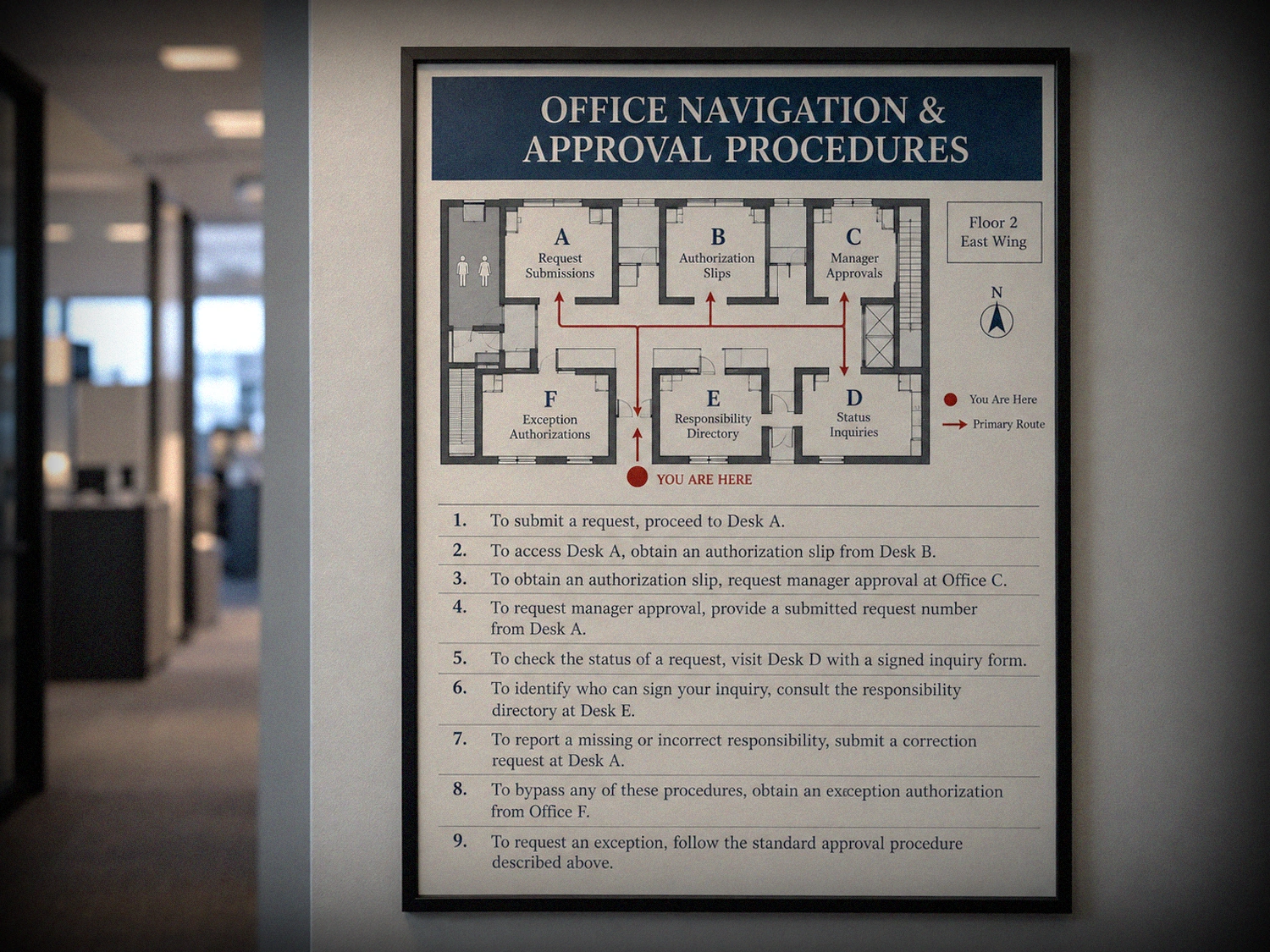
FIG 2 - The map of every step to take to reach office.
The path to take action is often buried beneath layer of bureaucracy. It is very important to establish a proper balance. Too many steps and interventions will make movement slow, and too little will provide no structure.
Knowledge work changes the coordination problem
In many knowledge-intensive activities, the person performing the work possesses information the supervisor does not. A software engineer may understand a technical dependency more precisely than the department head. A clinician may need to make a judgment at the point of care. A researcher may discover that the original question is unsuitable only after an experiment begins.
Such work cannot always be specified completely in advance. Requirements change, uncertainty is reduced through investigation, and quality depends on interpretation as well as compliance. A manager can establish the desired outcome and acceptable risks without being able to prescribe every step required to reach it.
Specialization also crosses departmental boundaries. Delivering a product change may require engineering, design, legal review, operations, and customer support. Each group has legitimate responsibilities, but no individual department controls the entire path from request to usable result.
Drucker's The Practice of Management and The Effective Executive place significant attention on objectives, contribution, and effectiveness. In this context, the key managerial question is not whether every action can be directed from above, but whether specialized efforts are aligned toward the result the organization needs.
Expertise at the point of work does not eliminate the need for organizational authority. Some trade-offs affect multiple teams, legal obligations, or scarce resources. What changes is the appropriate location of decisions: detailed technical judgment should not automatically be displaced upward merely because a managerial position exists.
Managing people and managing work are distinct issues
Managing people includes hiring, coaching, professional development, performance feedback, fair evaluation, support, and the resolution of interpersonal conflict. These activities concern the individuals and relationships through which an organization maintains its capability. Managing work concerns objectives, priorities, dependencies, ownership, sequencing, available information, decision rights, resource constraints, and feedback about results. These activities concern the movement of work through the organization.
The two complement each other, but neither can be a substitute for the other. A team may have a supportive leader yet lose workdays because of an absence of product ownership in the decision-making process. Process ownership can work perfectly despite poor training, workplace conflict, and excessive workload. Combining both sets of responsibilities within one job is sometimes practical. Problems arise when that combination becomes an assumption that every issue concerning work must pass through the manager of the people performing it.
When mixing personal management and work management, an organization risks confusing individual relationships with operational effectiveness. When every workflow, approval, or priority must filter through a person’s direct manager, interpersonal dynamics, reporting lines, and office politics inevitably attach themselves to tasks that should move purely on their merits. Work slows down not because the task is complex, but because it is forced to navigate an unnecessary layer of personal hierarchy. To advance properly, an organization must establish a clear separation: managing people ensures individuals are supported, developed, and treated fairly, while managing work relies on explicit systems, clear ownership, and transparent information flow. Treating work as a system rather than an extension of managerial oversight allows execution to stay fluid, objective, and unencumbered by personal friction.
A manager may be accountable for a team's development and commitments without personally assigning each action, relaying each question, or approving every ordinary technical choice. Conversely, distributing operational decisions does not remove the obligation to support people, evaluate performance responsibly, or resolve conflicts that teams cannot settle alone.
"An effective design asks which responsibilities are human and relational, which are operational, and where each can be performed competently."
When the manager becomes a traffic controller
Consider a routine product release involving three teams. One team completes the change, another must confirm operational readiness, and a third prepares customer communication. If every request, update, and handoff has to go through a single manager, everything stalls the moment that person gets busy.
The manager may work continuously while the release waits. Questions and approval move up the ladder instead of communicating with colleagues who are readily available and own the information. Status meetings attempt to reconstruct that already held information. An out-of-office manager can freeze the entire project, even though everyone with the actual skills to finish it is sitting right there.
This is an example of a failure mode, not a description of a real hierarchy. Central approval can be necessary when the decision involves substantial risk, policy exceptions, or conflicting organizational priorities. The problem is using the same centralized route for predictable coordination and high-risk decisions.
The resulting workload can be mistaken for evidence that more management is needed. A growing approval queue leads to an additional coordinator; the coordinator creates a new reporting process; that process requires more meetings. The company keeps adding people to manage the traffic without asking why all the traffic was sent down that narrow road in the first place.
"The more productive intervention may be to just change the route."
Managerial positions and managerial functions
Planning, allocation, coordination, and control are functions. They can be carried out by managers, by teams acting within defined authority, by shared operating procedures, or by information systems that make the required state visible. The functions remain necessary even when their execution is distributed.

FIG 3 - Manager looking at us from beyond.
It is not necessary to take exhausting measure to keep the workers in check or establish complex managerial systems. Instead, it is much more reasonable to recognize the ability of everyone to be able to be part of the systems and manage properly.
Instead of the same manager maintaining his personal schedule, the schedule for a plan may be a common one with a set of milestones. An expert, who qualifies himself within a technical threshold, can do the job. The service request can be directed to the designated owner of the service request. Dependencies are stored on a shared system; therefore, you will not have to gather its status repeatedly.
Distribution is not the same as ambiguity. Delegation works only when authority and accountability are explicit. If two teams assume that the other owns a decision, management has not become decentralized; it has become undefined.
This distinction also applies to automation. A workflow system can route a request, check whether required information is present, or notify the next responsible party. It cannot, by that fact alone, decide whether an exceptional risk is acceptable or who should be answerable for a harmful outcome. The question is not whether management functions can disappear. It is which functions require a person's intervention, and which can be reliably supported by the design of the work itself.
Orchestration is a property of the system
Orchestration describes the organization's capacity to turn intent into coordinated action across people, decisions, resources, and dependencies. It is not a synonym for a management job or a particular software platform. It is a quality of how work is arranged.
The starting point is clear intent: a defined result and an understandable reason for pursuing it. That intent needs boundaries, including priorities, available resources, quality standards, and limits on acceptable risk. Within those boundaries, appropriate autonomy allows decisions to occur where relevant information and competence exist. Autonomy requires explicit ownership. Each important result or handoff needs someone able to move it forward and answer for its completion. Ownership should be accompanied by usable information: current requirements, visible dependencies, recorded decisions, and a way to recognize changes that affect others.
Finally, work needs feedback and escalation. Feedback reveals whether coordination is producing the expected result; escalation provides a route for conflicts, exceptions, and decisions beyond delegated authority. Neither should require constant intervention in ordinary cases.
Useful structure can reduce the need for supervision
More rules do not necessarily mean more bureaucracy in the unproductive sense. A clearly documented interface may prevent recurring meetings. A transparent approval standard may eliminate requests for permission when conditions are already satisfied. An agreed definition of completion may reduce disputes at handoff.
Paul Adler and Bryan Borys distinguish enabling from coercive formalization in “Two Types of Bureaucracy: Enabling and Coercive” (1996). Their analysis highlights how formal procedures can help employees understand and perform their work or instead operate primarily as instruments of surveillance and constraint. The effect depends on design and use, not simply on the number of written rules.
Such distinctions make a difference in the functioning of organizations. A process that is capable of making the system more comprehensible, resolving issues, and explaining the consequences of small-scale actions on a larger scale can contribute to increasing autonomy. A process that requires permanent approval and does not increase any other value cannot.
"The aim is not fewer procedures as an absolute target. It is enough structure to make competent action possible without needless intervention."
Management will never be useless
An organization with clear decision rights still needs direction. Competing priorities cannot always be settled within one team, and difficult trade-offs may require judgment across the institution. Employees still need coaching, fair treatment, development, and support. Serious conflict, ethical concerns, emergencies, and failures of accountability need responsible intervention.
Mintzberg's descriptions of managerial work help explain why these demands cannot be reduced to task routing. Managers work through relationships, information, negotiation, and action. Their contribution is not exhausted by assigning tasks or signing approvals.
Designing a better work system can actually make the managerial role more demanding in the right areas. Rather than maintaining constant local control, managers must establish boundaries that are clear enough for autonomy, recognize when they no longer fit, and remain responsible for decisions with organizational consequences. They must also identify when a procedure hides an emerging problem instead of resolving it.
A manager who is no longer required to relay every update has more capacity to examine strategy, remove structural obstacles, develop people, and make difficult decisions. This is a possible gain from better orchestration; not a promise that there can be a model where every organization will need fewer managers.
The questions that reveal whether work is managed
Organizational charts answer one useful question:
who holds formal authority?
They rarely answer all the questions required to move a piece of work
from idea to realization.
For any important workflow, a more operational examination asks:
Who owns the result?
Who can make which decisions?
Who needs information, and when?
What depends on what?
Where must teams coordinate directly?
Which exceptions require escalation?
How will the outcome be evaluated, and how will the process improve?
These questions expose different design problems. Unclear ownership causes work to stall between teams. Decision rights that sit too far from the relevant information produce avoidable delays. Poorly defined interfaces create repeated clarification. Feedback that arrives only at the end allows errors to persist longer than necessary.
There is no universal arrangement that resolves every trade-off. A small creative team, a regulated institution, and a high-reliability operation need different degrees of standardization and control. The purpose of an orchestration model is not to prescribe one organizational chart. It is to make these choices explicit and revisable.
From management to orchestration
Management as a profession remains essential. Management as a hierarchy can be useful. Administration supplies continuity, and supervision can protect quality and accountability. None of these, however, should be mistaken for the whole process of coordinating work.
Management is something that can be done within a team, or for an individual, between parties, and stakeholders without the need of a middleman. A manager’s job is to coordinate mainly the complexities and the decisions prone to risks. In a way, the manager’s job is simply to be the one giving the order and carrying the burden of the decisions.
The more fundamental objective is to design an organization in which responsibilities are understood, information reaches the people who need it, routine decisions happen at the appropriate level, and exceptional decisions receive deliberate attention. Management contributes to that design without needing to be the route through which every action passes.
The purpose of management is not to create more management. It is to make coordinated work possible.
That distinction establishes the premise of the Orchestration series. When the default response to unclear ownership, broken handoffs, and slow decisions is another reporting layer or approval role, a predictable problem emerges; organizations begin creating more management to manage the management they already have.